Capitalism Doesn't Fix. It Reorganizes.
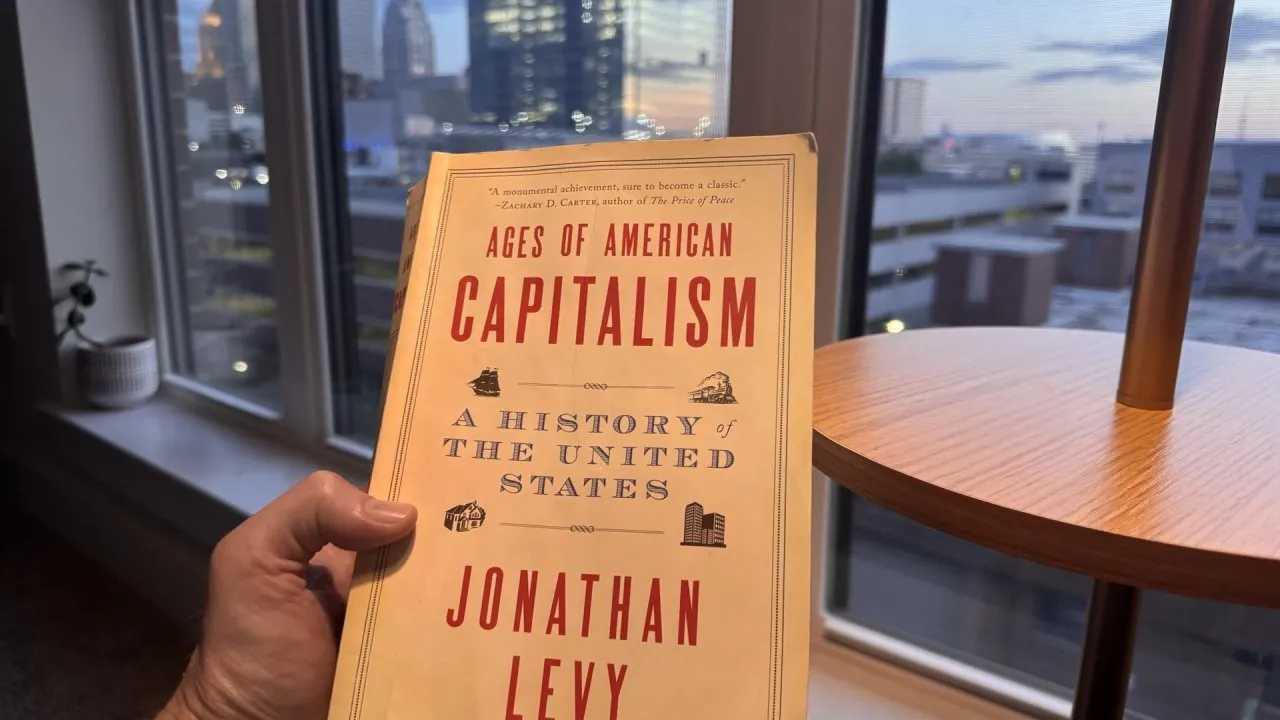
Capitalism has never been just an economic system. It’s a political project: about who holds power, and how that power adapts when old structures begin to give way to new ones.
That truth came into sharper focus after I read Ages of American Capitalism, a history of how four economic eras — Commerce (1660-1860), Capital (1860-1932), Control (1932-1980), and now Chaos (1980-) — have reshaped America.
The book gave me language for a moment in my own life I hadn’t fully contextualized.
I started my career at the U.S. Treasury during the 2008 financial crisis. I was 23, idealistic, in a suit and tie, sorting through complex loan files I barely understood — trying to grasp how any of it connected to a global financial system seemingly coming apart at the seams.
Back then, like many, I believed that if we could name the problems clearly and fix the incentives, we could build something better. A fairer economy. A more just world.
That belief stayed with me. In 2016, I wrote in It’s time to redefine capitalism in the 21st century:
We often measure prosperity in dollars. But maybe we should measure it in how many real human problems we’ve solved — and who has access to those solutions.
I still believe that. But over time, the limits of that hope became obvious; as did the complexity beneath it.
Capitalism isn’t a problem to be solved. It’s a dilemma to be navigated.
It doesn’t evolve through consensus or clarity. It evolves because power, risk and trust are continually reorganized. And power doesn’t yield to better ideas, it reorganizes itself. Quietly. Unevenly. Often without permission.
Today, I find myself working in Tulsa — at the intersection of public institutions, industry demands and philanthropic capital. It’s a front-row seat to systems under stress, and to the people doing their best to make them work anyway.
And all of this is happening as we likely enter a new age of capitalism.
AI is accelerating. Institutions are straining. Power is shifting. I don’t pretend to know what replaces the old order. But history tells us it won’t look like the last one.
We’re already seeing the outlines of what’s ahead:
- In the space between what cities dream of building, and what their institutions can realistically support
- In job transitions — accelerated by AI — that no degree, certificate, or training program is fast enough to meet
- In public systems expected to absorb every crisis — without the tools or trust to do it
I believe in philanthropy. I believe in markets.
But without a strong, functional public sector, neither can carry the weight of what’s coming.
Each age of capitalism reorganizes who holds risk and who holds leverage.
And places like Tulsa — nimble, ambitious, unfinished — are where that reorganization gets real. We’re not on the sidelines of this transition. We’re living it.
If you’re working through these tensions — whether in public service, business, education, or community — I’d love to have a conversation with you.