Building a Social Innovation Lab in North India
Last week I had the opportunity to speak at the Deshpande Symposium for Innovation & Entrepreneurship in High Education. The session was onCultivating Talent to Solve Social Problems. Preparing for it, I spent time reflecting on our work at the Jindal Centre for Social Innovation & Entrepreneurship (JSiE) over the last two years. In this post, I’ll use some of those presentation slides to share about this two year journey.
We established the Jindal Centre for Social Innovation & Entrepreneurship (JSiE) in September 2014. The motivation rose from a genuine concern about the future. Driven by explosive technological change, our world grows more connected, networked and complex. Our institutions and systems are are not keeping pace. As a result, we are losing trust in many of them. Meanwhile, serious social, economic and environmental challenges confront us. Present solutions to address these challenges are not working. We need new approaches, new solutions. We need to create the conditions for social innovation. We see this as the role played by a social innovation lab. We have drawn inspiration from social innovation lab models around the world. See some of them here. At JSiE, we are working create the conditions for social innovation in four ways.
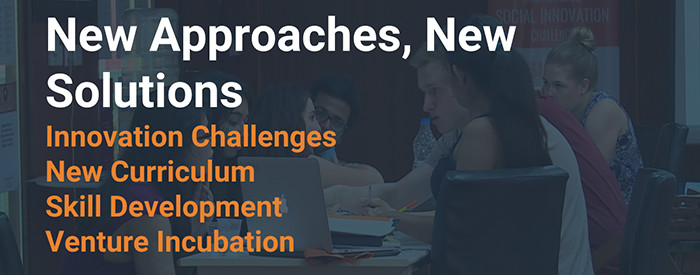
Social Innovation Challenges
Most of today’s innovative social solutions cut across the traditional boundaries. Social innovation happens when you convene diverse stakeholders, with diverse perspectives, motivated to find new solutions. In August 2015, we partnered with the Social Impact Lab at the University of Southampton and the Social Innovation Lab at Lahore University of Management Sciences to convene a diverse group of individuals around a common global challenge: empowering women through safer communities.
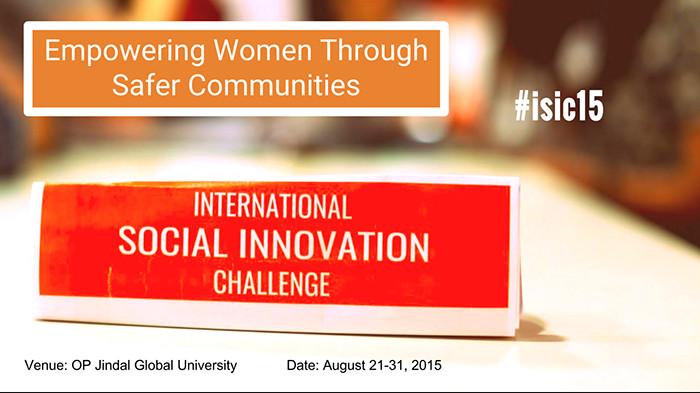
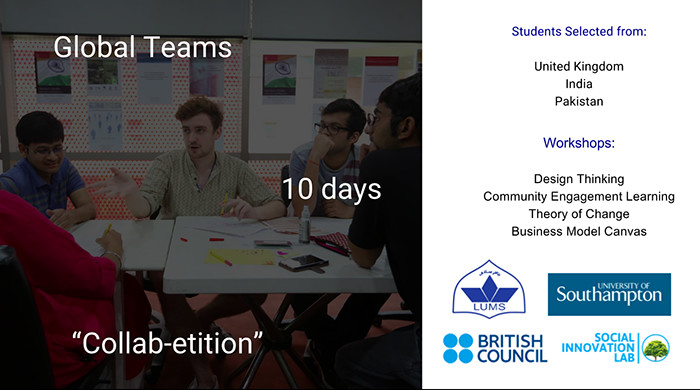
The challenge brought together competitively selected students from India, Pakistan and the UK. The format was a carefully thought out three-fold approach — to understand, to design, and to deliver a sustainable solution to the global social challenge. International teams were created and guided through 10 days of skill focused workshops. The aim was to facilitate the creation of sustainable social enterprises. We partnered with British Council India to bring together experts from various sectors working on the challenge of empowering women through safer communities.
The participating students were featured on a 30 minute segment on NDTV’s Head’s-Up program with anchor Natasha Jog. The challenge was also covered in the media here and here.
A key takeaway for participants was how similar the social challenge was in each country context. Working together on international teams was a catalyst to a deeper level of understanding of the challenge. New thinking emerged that transcended cultural differences.
In the video one participant explains her experience of traveling from Pakistan to India for the first time. You can find a full collection of students experiences here.
New Curriculum
The concept of social innovation has captured the imagination of practitioners, governments, foundations and universities around the world. Despite the growing interest, definitions remain unclear in this domain. As a result, there is often a lack of institutional support and resources for social innovation activities. Legitimacy is needed for further scale. We see academia as a key actor in this process, through research and designing new curriculum. We have partnered with the Middlesex University and Living in Minca to develop new curriculum we hope will reach across the world with the help of FutureLearn’s platform of 3.8 million learners.
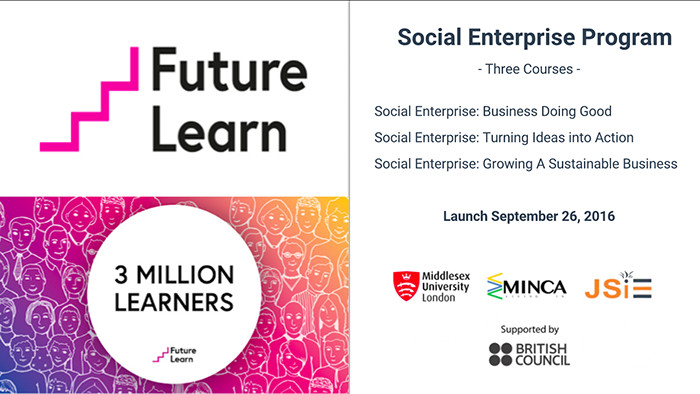
The FutureLearn Social Enterprise Program is a collection of three online courses soon to be available globally for free. In the future, we aim to repurpose the courses into blended learning academic curriculum and workshop modules. See the trailer for the first course below.
Skill Development & Venture Incubation
We know that it is impossible to predict what new solutions will work, so we need to experiment. Core to the vision of JSiE is to create an incubator for new ideas. We also aim to equip budding entrepreneurs with the tools to turn startup ideas into sustainable ventures. JSiE is a mission driven, non-profit incubator that provides early-stage venture support and skill development for aspiring entrepreneurs. Based in a University (OP Jindal Global University), JSiE is an incubation partner to the Tibetan Entrepreneurship Development initiative, a member of the UBI Global Incubation Impact & Network and a physical incubator on the StartupWavevirtual incubation platform.
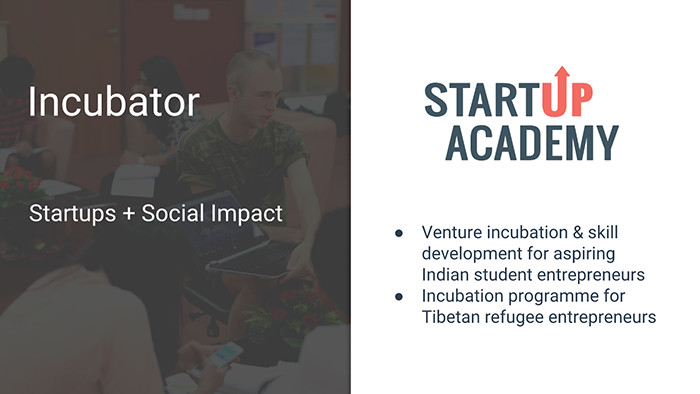
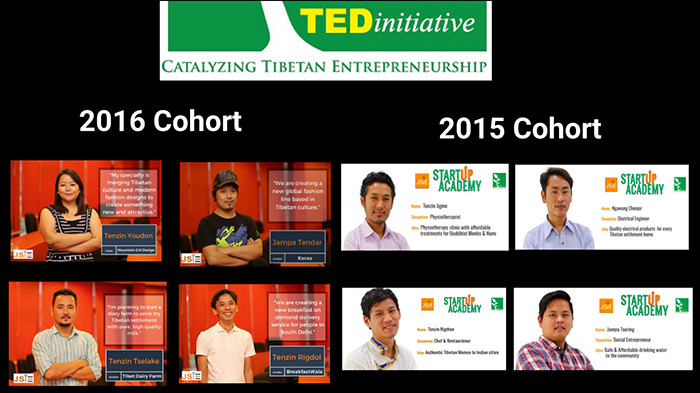
Over the last two years, 20 students from OP Jindal Global University have completed the Startup Academy skill development program. JSiE has also completed two incubation cycles with Tibetan refugee entrepreneurs. See the 2015 & 2016 cohorts below.
What’s Ahead?
JSiE is approaching it’s two year anniversary this September. We have learned a lot in this journey and will continue to build on our early successes and learn from early mistakes. Some of key goals for the next year: better documentation of our processes, more robust research, better engagement with government and the local community, and sharing our insights and best practices.
If you would like collaborate or partner with JSiE, please visit our website and get in touch.
Originally published on LinkedIn.